
Client Journey Map for Coaches: Find Every Lead Magnet on the Crossover Map
Every lead magnet your client would download is already sitting on her path. You find them by drawing a client journey map of that path, and I call mine the Crossover Map.
It takes one sheet of paper, with a sad face on the left and a happy face on the right. The jagged line between them shows you what to give away for free and what to sell.
What a client journey map should show a coach
A lot of the customer journey mapping templates online follow your sales process, from first contact to referral. That map is useful for your follow-up. It won't tell you what to make next.
The Crossover Map follows your client's own path. It starts where she is today and ends where she wants to be when you're done with her. Everything in between is a problem she has to solve to get there.
That's the map you want in front of you when you sit down to make a lead magnet, a reel or a program. You always want to come up with ideas from some point on your client's success path. That goes for your content, your lead magnets, your products and your programs. If an idea isn't on her path, none of your marketing is going to work.
Start with the sad face and the happy face
I'll use a made-up coach for this. Stacy Alderman is 48 and owns Hell's Bells, a boutique kettlebell studio for women over 40 on Sunset Blvd in Los Angeles. Her newest lead, Sarah Mathews, is 45 and runs her own business. Stacy and Sarah are made up, and nothing in this post is health advice.
Draw a sad face on the left side of the page. That's Sarah's current state, where she is right now.
Sarah hits snooze twice. She lives on coffee and drive-thru lunches, crashes at 3 PM and scrolls Instagram in bed until midnight. She keeps telling herself she'll start on Monday, once work slows down. And underneath all of it, she's quietly terrified that she's getting older without really living.
Now draw a happy face on the right side. That's her desired state, where she wants to be when Stacy is done with her.
Sarah is up on the first alarm. She eats real food she actually likes and moves at home most days. Her clothes fit and people are complimenting her. Her energy lasts all day, she wants to travel and put herself out there again and she feels confident and in control.
Write both faces in her own words. The more specific you get, the easier the rest of the map gets.
Draw the jagged path and mark the hash marks
Connect the two faces with a jagged line climbing up a hill. Real change is never a straight line. It goes up, and down, and up again.
Then put hash marks on that line. Every hash mark is one of 4 things.
An action she has to take.
A decision she has to make.
An obstacle she has to get past.
Or a piece of information she has to learn.
For Sarah, getting up on the first alarm is an action. Starting this week instead of "on Monday, once work slows down" is a decision. Scrolling in bed until midnight is an obstacle. Knowing how much protein to eat at lunch is information. Those 4 tags are my read of her map. Your client's map will have a lot more hash marks than 4.
Lead territory, buyer territory and the crossover point
Now look at the middle of the line.
On the first half of the path, Sarah is running from pain. Her pain is high and her belief that she can change is low. That's lead territory, and it's where your lead magnets live.
Then somewhere in the middle, she gets a few small wins, and success starts to breed motivation. A psychologist named Albert Bandura called this self-efficacy. Once people prove to themselves they can do something small, they start believing they can do something bigger.
That's the crossover point. Her pain is falling and her desire is rising, and the 2 lines cross. Sarah stops running away from the sad face and starts running toward the happy face. Now she's in buyer territory, where your programs and your products live.
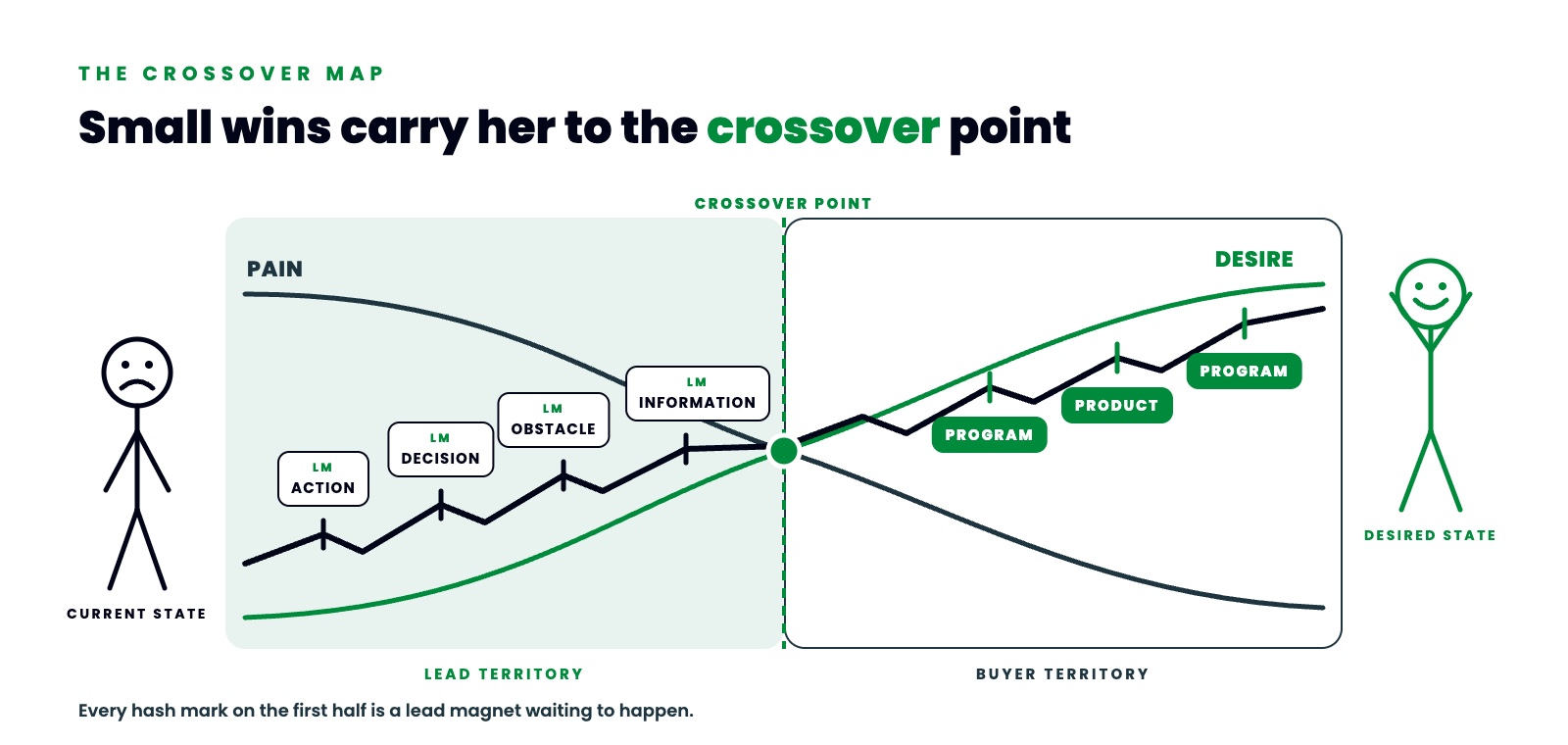
This is why a lead magnet that sells the whole transformation struggles. It's asking a woman in lead territory to act like a buyer. She doesn't believe she can get to the happy face yet. She needs a small win first.
Every hash mark on the first half is a lead magnet waiting to happen
When a coach asks me what lead magnet to make, I tell them to look at the first half of their map.
You can splinter off a small piece of information. You can help her get past a small obstacle, make a clearer decision or take a simple action that moves her closer to the crossover point. Each one is small enough to give away and solve fast.
Stacy's map turns into lead magnets like this.
The information hash mark becomes her protein plan: "Lose Your Fat. Keep Your Muscle. 25 Quick Ways to Hit 25 Grams of Protein at Every Meal." Sarah can use it at lunch tomorrow, and the last page invites her to a free class at the studio.
Her action and obstacle hash marks turn into "5 Quick Snooze-Proof Morning Moves to Feel Energized Before Work" and "5 Easy Phone-Down Bedtime Swaps for Deeper Sleep Tonight."
Each one hands Sarah a small win she can feel, and each small win walks her closer to the crossover point. By the time she gets there, Stacy's program is the obvious next step.
The second half of the map is where you build what you sell. A full program belongs past the crossover point, because that's where Sarah finally believes the happy face is possible for her.
How to draw your own Crossover Map this week
This is how I'd draw one. Change any step to fit how you work.
Pick one ideal client. If you serve 2 different people, draw 2 maps.
Write her sad face first. Use what she does and what she keeps telling herself. Then write her happy face the same way.
Draw the jagged line and fill it with every action, decision, obstacle and piece of information you can think of. Don't sort them yet.
Mark where her small wins would start to stack up. That's your crossover point. Everything to the left of it is lead territory.
Circle the hash marks closest to her sad face. Those are the problems she feels today, and they're the first lead magnets to build.
Then keep your client journey map where you can see it. Every reel, email, lead magnet and program idea should point to a spot on it.
FREE AVATAR X-RAY LITE
Get the free Avatar X-Ray Lite
The hardest part of the map is the sad face. Your client won't tell you what she's really afraid of, so I built a Claude skill that X-rays her for you.
The Avatar X-Ray Lite is free. Upload your avatar summary and her picture, and in about 10 minutes you get a printable X-Ray with 25 layers in 3 levels. X is what's happening on the outside and Y is what she wants and tells herself. The shadow is the fear she won't say out loud. You also get the questions running through her head, her own words and 10 lead magnet ideas aimed at the first half of her map. It works on any Claude plan, even the free one.
Get it here: https://sites.mythriveengine.com/xray
The full video is on my YouTube channel, Brian Devlin: [YouTube link after Premiere]
I've been coaching since 2001, and today more than 140 coaches run their business on Thrive Engine. Want help building your own lead system inside Thrive Engine, from the opt-in pages to the follow-up? Book a Thrive Engine demo.
