How to Use Client Success Stories in Your Nurture Emails
Your best client success stories ask your lead to pick a side. In my 10 email nurture sequence, email 7 is the client story email, and it ends with one question for your lead. Which camp do you want to be in?
This post shows you how to write that email. You'll lay out two camps, tell one real client's story in her own words, and close with the question.
Why client success stories work when your lead picks a side
Email 7 is built on an us versus them idea from a psychologist named Henri Tajfel. His work is known as social identity theory. In the video I put it this way: "He found that people pick a side fast, and once they do, they act like the group they joined."
So the client story in email 7 shows your lead two groups and lets her see which one she belongs in. Once she decides she's in the group that hires a coach, she starts acting like someone who hires a coach.
That's social proof marketing done inside an email. Your lead watches somebody just like her make the choice first.
Meet Jen, Carol and Linda
I'll show you with three example characters from my latest video. Jen, Carol and Linda are all made up for this example.
Jen is a 48 year old fitness coach. She helps women over 40 lose weight on a GLP-1 without losing their muscle. Her lead magnet is "Lose Fat, Not Muscle on Your GLP-1," a 5-day bodyweight workout and protein plan. Her $1,495 program picks up where the plan leaves off.
Carol is Jen's newest lead. She's 51 and she's been on the shot for three months. By the time Carol opens email 7, she has already read six emails from Jen. Those emails helped her see she has a problem and knocked out the excuses she was leaning on.
Linda is the client in Jen's story. She's 52.
Lay out the two camps
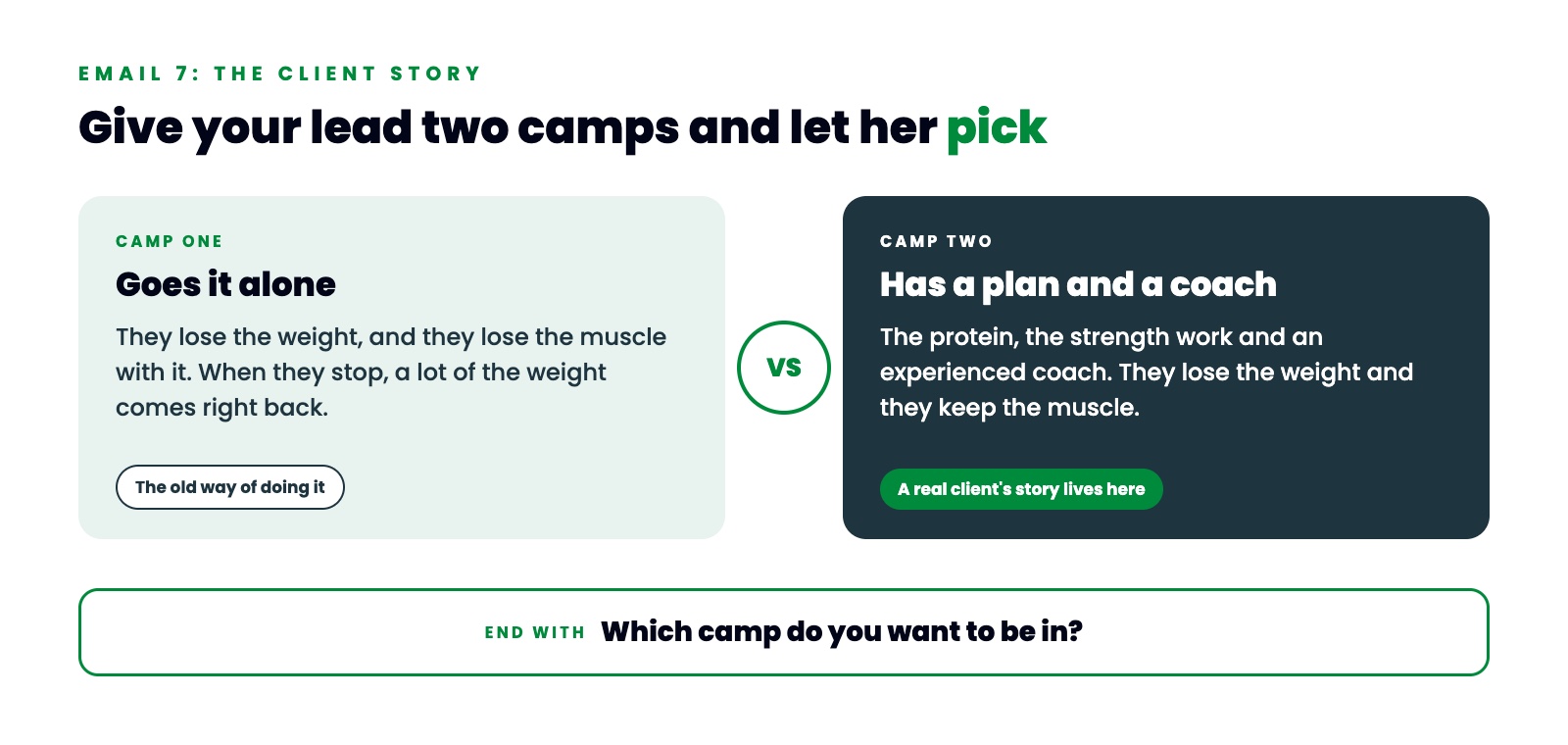
The first half of the email describes two kinds of women on a GLP-1. Carol should be able to picture both of them by the time she's done reading.
Camp one goes it alone
The first group goes it alone. They lose the weight, and they lose the muscle with it. When they stop, a lot of the weight comes right back. Plus they've weakened or even damaged their metabolism in the process.
Write this camp with care. Carol is probably in it right now. Describe it so she recognizes herself without feeling attacked.
Camp two has a plan and a coach
The second group does it the right way. They have the protein, the strength work and the guidance of an experienced and qualified coach. They lose the weight and they keep the muscle. They titrate off the medication without any rebound effect when they hit their goal weight.
Camp two should sound like the place Carol wants to end up. Use the outcomes your program promises and only the outcomes your clients have really had.
You can build the same two camps for any coaching niche. Camp one is whatever your lead is doing right now on her own, written the way she'd describe it. Camp two is the same person with a plan and a coach in her corner. Pull the details for both from your sales calls and from what your clients told you before they joined.
Tell one real client's story in her own words
Once the two camps are on the page, you tell the story of one client from camp two. In Jen's email, that's Linda.
Linda was sure she had it all figured out too. That detail matters, because it's exactly where Carol is sitting. The email shares what Linda learned, what she and Jen did about it, and how she feels now, in her own words.
Then dig into Linda's past, present and probable future. Show where she was when she started and where she is today. Then show where she's headed now that she's in camp two. That gives Carol a three dimensional view of Linda's journey.
I'm not going to write Linda's words here, because Linda doesn't exist. Your version of this email needs a real client and her real words. Never write a quote for a client or round her results up. If you don't have the story yet, the next section shows you how to get it.
End with one question
The email ends with one question for Carol. Which group do you want to be in?
Keep the question simple and leave it at the bottom of the email. Carol has just watched somebody like her make it across, so she's ready to answer it.
Watch who you put in the "them" group. In this email, the them is always an old way of doing things, and nobody gets made fun of. Camp one is women going it alone with no plan. Leave named people, other coaches and clients who quit out of it. If Carol feels judged, she stops reading.
How to ask for a testimonial you can actually use
A client story email needs your client's past, present and future, told in her own voice. You get that from a real conversation with her.
Here's what I said about it in the video: "I made Linda up for this example. So when you write yours, you use a real client if you can. Ask them to jump on a zoom with you and share their journey. The recordings or transcripts are gonna contain pure gold, trust me."
So when you're working out how to ask for a testimonial, ask for a conversation. Pick a client who's in your camp two and who started where your leads are starting now. If your leads think they've got it handled, pick the client who once thought that too. Get her on a Zoom call and record it. Ask her where she was before she joined, what changed while you worked together and what she sees coming next. Then let her talk.
After the call, pull your story from the transcript. Use her phrases, her details and her numbers. Ask her if you can share it, and send her the email before it goes out. Her words will sound like your next client's words, because they come from someone who was in the same spot.
Where the client story email fits in your sequence
Email 7 sits at the end of the heavy lifting. Emails 2 through 7 do the work on your lead's beliefs. Emails 8, 9 and 10 are the countdown, and email 10 is your hard pitch.
That placement is on purpose. Carol meets Linda right before Jen opens the doors to her program in email 8, so the countdown starts after she's seen the proof.
Your client success stories don't stop at email 7 either. Email 9 answers the questions Carol might still be chewing on, and it's a great time to link to a case study or a highlight reel if you have one.
Once your emails are written, you build them into a workflow inside a CRM like Thrive Engine, so every new lead gets them in order, one per day. Your job is to read the replies and answer the people who write back.
I walk through all 10 emails and the psychology behind each one in the full video, How to Get Coaching Clients With Email (Why Your Follow-Up Isn't Working). Watch it here: [VIDEO LINK]
FREE LEAD NURTURE PLAYBOOK
Get the free Lead Nurture Playbook
The Lead Nurture Playbook gives you all 10 emails written out in full, the psychology behind each one, and the AI prompt to make them your own.
Comment NURTURE on any of my posts, or DM NURTURE to @mythriveengine on Instagram, and I'll send it to you.
Want help building your own nurture system? Book a Thrive Engine demo.
