
Commitment and Consistency: Give Your Lead One Small Job
The best way I know to get buy-in from a new lead is to give her one small job she can finish tonight. Once she finishes it, a principle called commitment and consistency starts pulling her toward the next step.
This post shows you how I use commitment and consistency inside a nurture email. You'll see the exact job I'd give one lead and how to write one for your own leads.
Telling a lead to change gets you pushback
When a lead grabs your lead magnet, it's tempting to tell her what she's doing wrong. You know the answer. You've watched clients make the same mistake for years.
So you write an email that lays it all out. She reads it and feels judged. Or she skims it and moves on.
I said it plainly in my latest video. "If we tell the prospect to change, we're gonna get pushback. Trust me, I know."
A lead has to own the decision before she acts on it. In the video I put it this way. "The prospect needs to feel like the idea to change is all theirs."
So a good nurture email leads her to the idea and lets her get there first.
What commitment and consistency means
Commitment and consistency comes from a psychologist named Robert Cialdini. It's one of his principles of persuasion, and some people call it the consistency principle.
This is how I explain it. "Once we take a small step, we like to keep walking in the same direction."
People want what they do next to match what they already did. After someone takes a step, the next step in the same direction feels natural. Turning back would feel like going against herself.
In sales, those small steps are often called micro commitments. A micro commitment can be as small as a reply to an email or a number written on a scrap of paper.
The first step has to be small. If the first thing you ask for is a $1,495 program, there's nothing small about it.
Meet Jen and Carol
I'll show you with two example characters from my latest video. Jen and Carol are made up for this example.
Jen is a 48 year old fitness coach. She helps women over 40 lose weight on a GLP-1 without losing their muscle. Her lead magnet is "Lose Fat, Not Muscle on Your GLP-1," a 5-day bodyweight workout and protein plan. Her $1,495 program picks up where the plan leaves off.
Carol is Jen's newest lead. She's 51 and she's been on the shot for three months. She grabbed Jen's plan, and she's convinced she can figure this out on her own.
Jen could write Carol a long email about why she's wrong. Carol would push back, and Jen would lose her.
Email 4 gives Carol one small job
I send 10 emails over 10 days, and each one has its own job. Email 4 goes after the belief that Carol can figure this out herself.
In this email Jen hands Carol one small job.
"Carol, tonight, write down everything you ate today and add up your grams of protein."
The task takes a few minutes and ends with one number. Once Carol writes that number down, she has taken a step. Commitment and consistency says she'll want her next step to match it.
In the reel for this video I said it like this. "So when she adds it up and sees how far off she is, she's going to believe her own math a lot faster than she'd ever believe you."
Carol found the gap with her own pen and her own food. So the idea to get help is hers. And all of a sudden, a coach doesn't sound like a bad idea.
Keep it small enough to finish tonight
Writing down one day of food is something Carol can do before bed. If the job felt like homework, she'd put it off and forget it. A small job gets done.
Make it end in a number
A number is hard to argue with when she wrote it herself. It also gives her something real to reply with.
Tie it back to your lead magnet
Jen's plan is about protein and keeping muscle. So the job sends Carol right back to that message. Every email I write points back to the core message in the lead magnet, and the lead magnet points to the offer.
Commitment and consistency examples across 10 emails
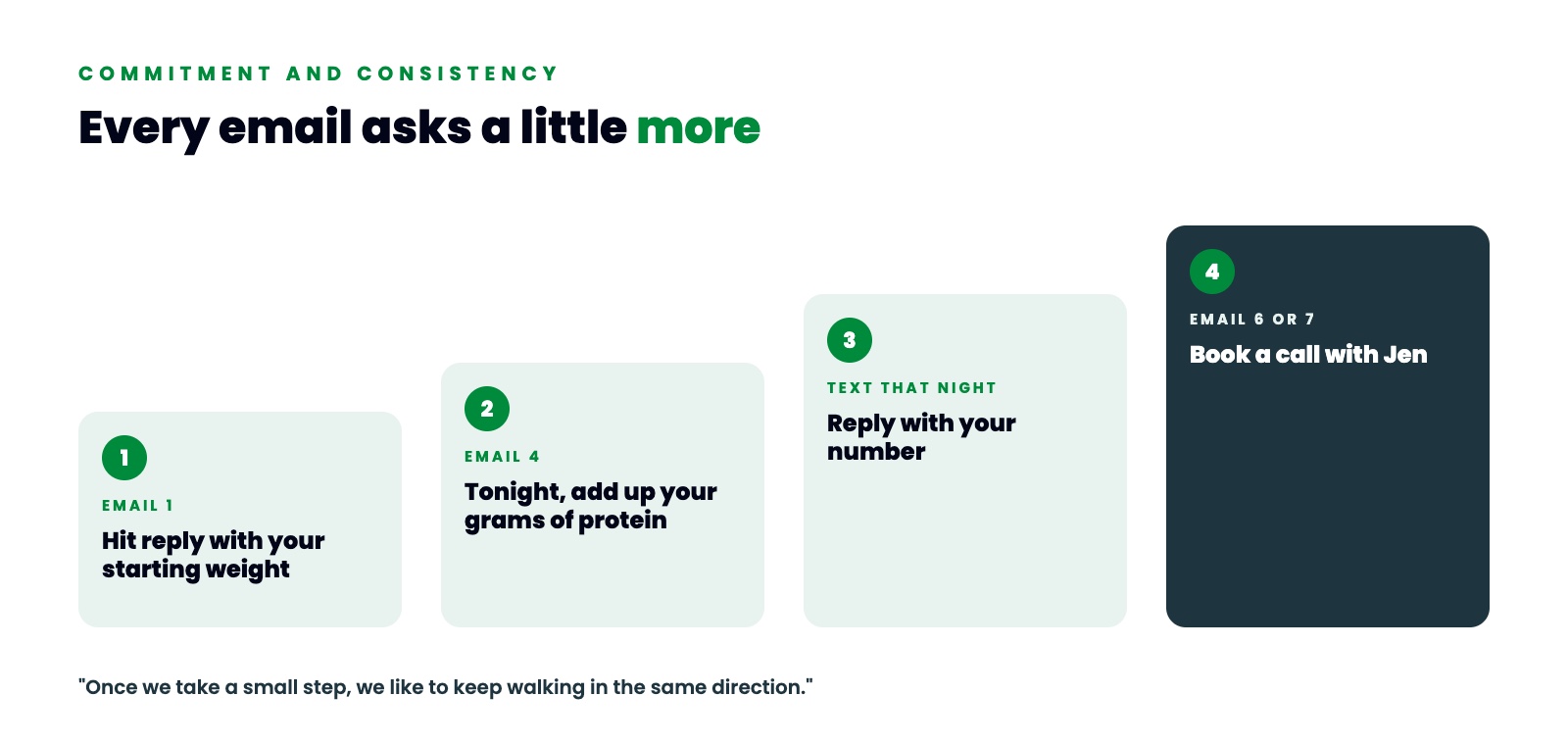
One small job works best when it's part of a bigger path. I've done at least a few million dollars in personal sales with email over the last 10 years. In my sequence, every email asks a little bit more than the one before it.
In email 1, the PS asks Carol to hit reply and tell Jen her starting weight, her goal weight and her time frame. Jen tells her she reads and replies to every email. That reply is Carol's first small step.
In email 4, Carol adds up her protein grams.
Alongside the emails, I also send a short text or DM that matches each one. I keep them under 150 characters. So the night email 4 goes out, Carol might get a text that says, "Hey, Carol, did you add up your protein grams today?" The next line asks her to reply with her number.
By email 6 or 7, Carol is getting links to book a call or to look at the offer in more detail.
Each ask is a little bigger, and each one matches a step she already took. By the time Jen asks her to book a call, saying yes feels like the next step in a direction Carol already picked.
How to write your own one small job
Start with the number your lead has never counted. For Jen's leads, it's grams of protein. Ask yourself what your best clients track that your new leads ignore. That's your number.
Turn it into a job she can do tonight. Use her first name, give her one task and ask for one number. Keep the wording short and friendly, the way Jen does.
Ask her to send the number back. A reply is another small step. It also opens a real conversation, and you're the one who answers it.
Send a short text that matches the email. Ask one question, under 150 characters.
Give the email room around the job. Each email runs at least 300 to 400 words, because the real story needs room to breathe. The job is one line inside that story.
Once your emails are written, you build them into a workflow inside a CRM like Thrive Engine, so every new lead gets them in order, one per day. Your job is to read the replies and answer the people who write back.
Commitment and consistency works when the first step is small and the lead takes it herself. Give your leads one small job this week and see who writes back with a number.
I walk through all 10 emails and the psychology behind each one in the full video, How to Get Coaching Clients With Email (Why Your Follow-Up Isn't Working). Watch it here: [VIDEO LINK]
FREE LEAD NURTURE PLAYBOOK
Get the free Lead Nurture Playbook
The Lead Nurture Playbook gives you all 10 emails written out in full, the psychology behind each one, and the AI prompt to make them your own.
Comment NURTURE on any of my posts, or DM NURTURE to @mythriveengine on Instagram, and I'll send it to you.
Want help building your own nurture system? Book a Thrive Engine demo.
