
Email Marketing for Coaches: What to Send After Your Lead Magnet
Somebody comments your keyword and your lead magnet lands in their DMs in seconds. You feel great. Then nothing happens. No reply comes back and no call gets booked.
So you decide the lead magnet wasn't good enough, and you build or buy another one. Please stop. Email marketing for coaches starts the minute that lead magnet goes out. This post walks you through the 10 email nurture sequence I use, how I write each email and what results to expect.
Why your lead magnet keeps getting the blame
Your lead magnet's probably fine. They got it and they moved on because nobody followed up the right way.
Think about what already happened. A stranger saw your post and raised their hand for your offer. If the next thing they get from you is silence, they go back to scrolling. A second lead magnet puts you right back in the same spot with a new download and the same silence after it.
I've sold with email for a long time. Years ago I shipped a coaching program on DVD to people in 26 countries, and the only marketing I had was YouTube and email. Later I built a software company to $60,000 a month in revenue, and email was responsible for the bulk of those sales too. Over the last 10 years I've done at least a few million dollars in personal sales with email, with a list not much bigger than the number of people subscribed to my YouTube channel.
The email marketing for coaches plan in one line
The fix is a 10 email nurture sequence where every email points back to your lead magnet and your lead magnet points to your offer.
I'll use our example coach Jen to show it. She's 48 and helps women over 40 lose weight on a GLP-1 without losing their muscle. Her lead magnet is "Lose Fat, Not Muscle on Your GLP-1," a 5-day bodyweight workout and protein plan. Her $1,495 coaching program picks up where the 5-day plan leaves off.
A good lead magnet names a problem and helps the reader see herself in it. Then it pours a little gasoline on that problem and shows the way back to safety. Copywriters call this problem, agitation, solution. Jen's 5-day plan does that, and her program is the full way out. So every email she sends goes back to the messages inside the plan, and the plan leads to the program.
What each email in your nurture sequence does
I send 10 emails over 10 days, one per day. Each one has its own job.
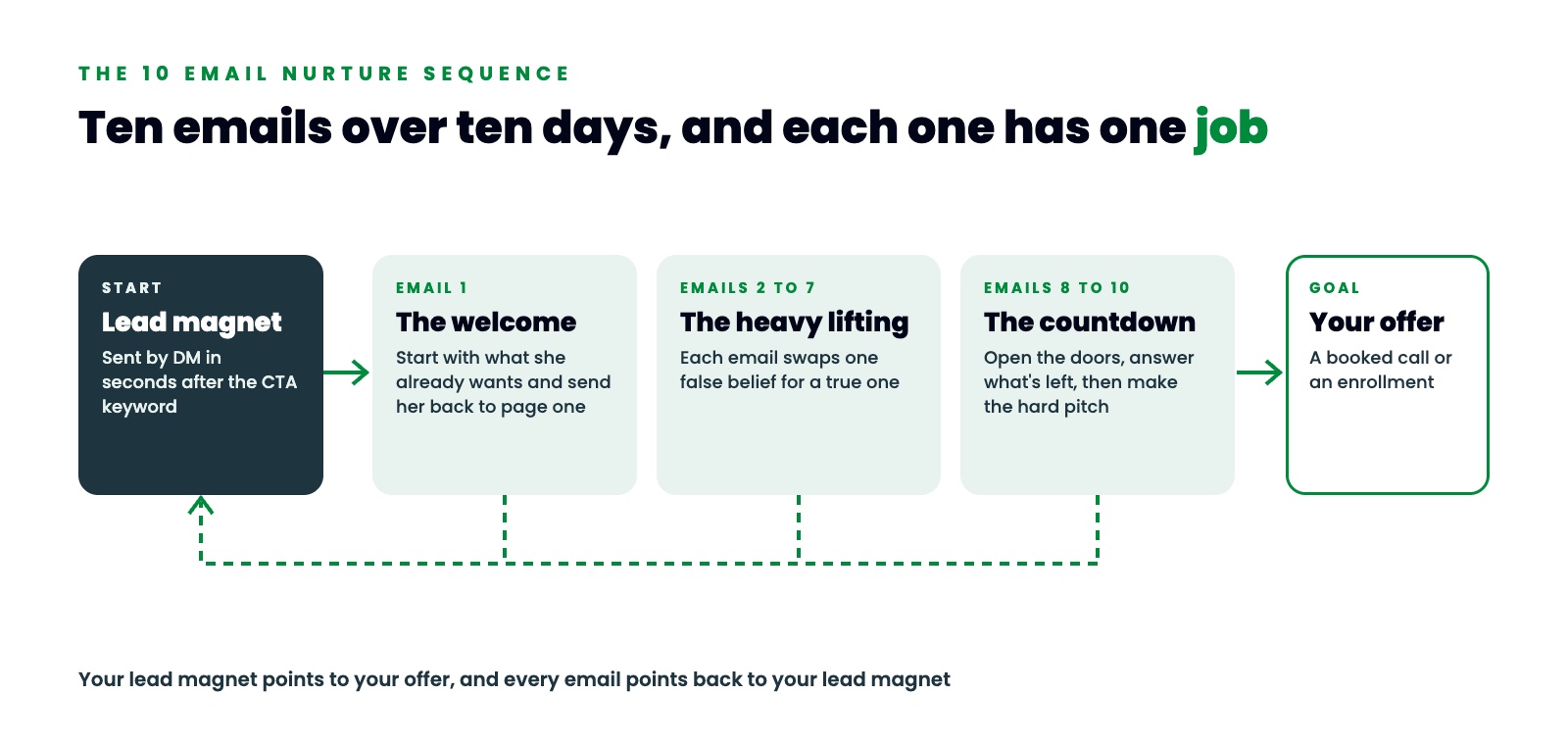
Email 1 is the welcome
This is the email I'm most careful with. It's built on an idea from a copywriter named Eugene Schwartz. His point was that you take what people already want and point it in a new direction.
So Jen opens with what her new lead already wants, which is the scale going down. Then she plants a new thought. The scale can't tell you what you're actually losing. Then she sends her back to page one of the plan.
The P.S. cracks the door open. Jen asks her to hit reply with her starting weight, her goal weight and the time frame she's working with. She adds that she reads and replies to every email.
Emails 2 through 7 do the heavy lifting
These six emails work on what your lead believes. The first three help her see she has a problem. The next three knock out the excuses she's been leaning on. Email 7 tells a client story.
The goal of every email is to take away one false belief and put a true one in its place. And every one of them sends her back to the core message in your lead magnet.
Emails 8, 9 and 10 are the countdown
Email 8 opens the doors to the program and shows her you're the right coach. Email 9 answers whatever she's still chewing on, and money is usually the big one. Email 10 is your hard pitch.
The P.S. asks for a little more each day
Early on, the P.S. just asks for a reply or mentions that you have a program that helps with this topic. By email 6 or 7, your lead gets a link to book a call or to check out the offer in more detail.
How to write lead nurturing emails people read
Treat the subject line as your headline
David Ogilvy, one of the greatest ad men ever, found that five times as many people read a headline as read the ad copy. In your email, the subject line is your headline. If the email doesn't get opened, nothing inside it matters.
Write for a phone screen
Open with "Hi" and your lead's first name. Then give every sentence its own line, because she's probably reading on her phone.
Many studies have shown that the eye moves less than 64 characters across a line. Text that runs all the way across the page won't get read. Big blocks of text get scrolled past too. So each line should sell the scroll to the next line.
Give the story room to breathe
Each email should run at least 300 to 400 words. You're building a real argument, and it needs space.
End every email with the same signature sign-off, so your lead starts to remember your one message. Add a P.S. with a soft invitation. A lot of people scroll to the bottom before they read the email, so the P.S. is often the first line they see.
Send a short text with each email
Alongside each email, I send a short text or DM that matches it. I keep them under 150 characters. A quick question that asks for a one-line reply works well.
What to expect from your nurture emails
Not everybody who gets these 10 emails will open them, read them or buy from you. Most won't, and that's completely normal. Somewhere between 1 and 5 percent of your leads becoming clients is considered very successful.
Run the math on Jen. Her program is $1,495. Say she enrolls 2 out of every 100 leads. That's a 2% conversion rate and roughly $3,000 for every 100 emails she collects.
You won't know your own conversion rate on day one. Collect your first 100 leads and count how many became clients. Now you've got your number.
That number only holds up if the rest of your system holds up. Your booking page or checkout page has to convert at normal rates, and your show rate on sales calls needs to stay steady. Your onboarding also has to be tight enough that people aren't asking for refunds.
So give the sequence a fair shot before you pull the plug on it. Getting clients is a lot more about math than personality.
Where your email nurture sequence lives
Once you've written the emails, they go into a workflow inside a CRM like Thrive Engine. You build that workflow once. From then on, every new lead who asks for your lead magnet gets the 10 emails in order, one per day, and your job is to answer the people who reply.
That's how email marketing for coaches keeps paying you back after the download. Every lead who comments your CTA keyword starts the same 10 days. Every one of those days points back to your lead magnet and on to your offer.
I walk through all 10 emails and the psychology behind each one in the full video, How to Get Coaching Clients With Email (Why Your Follow-Up Isn't Working). Watch it here: [VIDEO LINK]
FREE LEAD NURTURE PLAYBOOK
Get the free Lead Nurture Playbook
The Lead Nurture Playbook gives you all 10 emails written out in full, the psychology behind each one, and the AI prompt to make them your own.
Comment NURTURE on any of my posts, or DM NURTURE to @mythriveengine on Instagram, and I'll send it to you.
Want help building your own nurture system? Book a Thrive Engine demo.
