How to Script Reels Using AI: Same Claude, Different Reel
If you want to know how to script reels using AI, start with what Claude knows before you type a word. A coach can type the exact same prompt twice and get two very different reels back.
The first reel sounds like every other coach on Instagram. The second one talks to one woman about one number she cares about. Both came from the same one-line prompt. The second one had a coach brain behind it.
Below I'll walk you through both reels and what Claude knew each time. Then I'll show you how to set up the same thing for your own business.
Jen's prompt and the reel Claude gave her
I'll use our example coach Jen to show you how this works. Jen is 48. She helps women over 40 lose weight on a GLP-1 without losing their muscle. She's good at it, and local physicians refer their GLP-1 patients to her. Her program is $1,495.
Jen and her client Carol are made up, and nothing in this post is health advice.
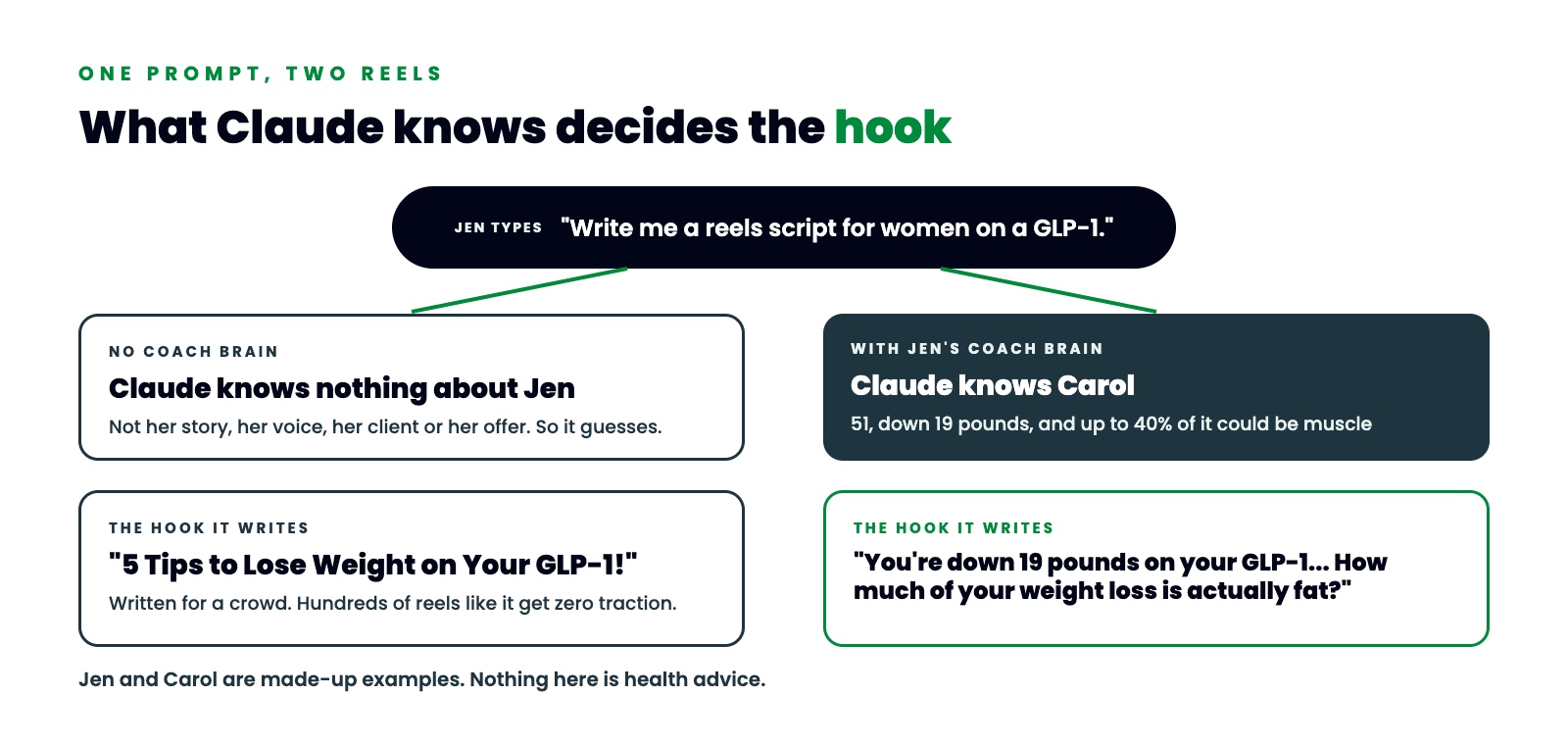
Jen opens a new chat in Claude and types one line. "Write me a reels script for women on a GLP-1."
Claude hands her a script with this hook. "5 Tips to Lose Weight on Your GLP-1!"
Nobody is going to watch that reel. There are hundreds of reels with that same hook getting zero traction. If Jen films it and posts it, she burns her time and her energy on a reel that brings her no leads.
Why AI content for coaches comes out generic
Claude did exactly what Jen asked. It just had nothing to work with.
When Jen opened that chat, Claude had no idea who she was. It didn't know her story or how she talks. It didn't know who her dream client is or what she sells. So it guessed.
When AI guesses, you get generic everything. A hook like "5 Tips" is written for a crowd of strangers. And generic content does not get leads.
Jen doesn't coach a crowd. She coaches one kind of woman, and her reel has to make that woman stop scrolling. Claude can't write for a woman it has never heard of.
The same prompt with a coach brain behind it
Now Jen asks again. This time Claude reads her coach brain first. A coach brain is a folder of 10 files that Claude reads before it writes a single word for your business.
So before it writes anything, Claude already knows Jen. It knows her dream client is Carol. Carol is 51. She's down 19 pounds on her shot, and she's convinced she's crushing it.
Claude also knows the danger Carol can't see. Up to 40% of the weight she's losing could be coming from muscle.
It knows how Jen talks and what her $1,495 program promises. It even knows the CTA keyword that sends Carol to Jen's lead magnet.
This is the hook it writes. "You're down 19 pounds on your GLP-1... How much of your weight loss is actually fat?"
Jen used the same Claude and spent the same five seconds typing. She got a completely different reel because Claude finally knew who it was talking to.
What makes the second hook work
Look at what Claude put in that first line.
It talks to one person. Carol sees "down 19 pounds" and knows the reel is about her. A woman who isn't on a GLP-1 keeps scrolling, and that's fine. Jen doesn't need her.
It starts with Carol's win. She already feels great about the scale, so the opening agrees with her before it asks anything of her.
Then it asks a question Carol hasn't asked herself. She's been watching the number go down. She hasn't asked how much of that loss is fat and how much is muscle. That question is the reason she keeps watching.
Claude could only write that hook because Carol's numbers, Carol's hidden danger and Jen's voice were already on file. Take those away and you're back to "5 Tips."
How to script reels using AI with your own coach brain
Your coach brain has 10 files. Three of them do most of the work on a reel. Those are your Avatar file, your Tone file and your Coach file.
Avatar.md holds your dream client and your offer
This file is your ideal client and your offer in one place. It answers who she is and what her Tuesday looks like. It asks what she's quietly afraid of before she books a call. It asks what she says in her own words when she describes being stuck.
Claude even searches Reddit and reviews for the exact phrases people like her use. Then it saves your offer right next to her. That covers what it costs, how it's delivered, who it's for and who it's not for. It also covers what she gets, in what time frame, and without what headaches.
For Jen, this is the file where Carol lives with her 19 pounds and her hidden muscle loss. That file is how Claude got from "women on a GLP-1" to Carol.
Tone.md holds how you talk
This file holds the words you always use and the words you would never say. It also covers how you sound in a sales email compared to a quick check-in text to a client.
Claude pulls these rules straight from real posts and emails you've already written. So when it writes your reel, it writes the way you speak on camera.
Coach.md holds your story and what you believe
This file answers how you ended up coaching and what you walked away from to build your business. It asks what your message for the world is.
It also asks what you believe about your niche that other coaches would push back on. That last answer is gold. Your real opinions are what make your reels sound like you instead of everybody else.
The other seven files cover your rules for Claude, your brand, your business facts, your links, your systems and the lead magnets you've already built.
Write your next reel with your coach brain
Start by building your coach brain one time. With the right prompts, Claude interviews you one question at a time and writes all 10 files. It takes about 45 minutes.
Keep every file in one folder on your computer called Coach Brain. Open Claude in that folder whenever you work on your business, so it reads your files before it writes.
Then ask for the reel in plain words. Jen's prompt was one short line both times. You don't need a long prompt when Claude already knows your client.
Before you film, read the hook as your dream client would. Does it name her situation and use a number she knows from her own life? Would she stop on it, or would it feel like every other reel she scrolled past today? If it could be about anyone, tell Claude what's missing and ask again.
A reel is the small win
A single reel that lands is the small win. The big win is what happens when you stack skills on top of a brain.
A skill is a set of instructions Claude uses to do one task the same way every time. I have hundreds of skills that run my business.
Years ago I shipped a coaching program on DVD to people in 26 countries. Later I built a software company to $60,000 a month in recurring revenue. Today more than 140 coaches run their business on Thrive Engine. Every automated system they run, from their daily content to their lead follow-up, runs from their coach brain.
That's how to script reels using AI that sound like you and speak to the one person you're best at helping. Give Claude the brain first, and the reel comes out right.
The full video is on my YouTube channel, Brian Devlin. Watch it here: https://www.youtube.com/@briandevlinmedia
FREE COACH BRAIN BUILDER
Get the free Coach Brain Builder
The Coach Brain Builder gives you the prompts that build your 10-file coach brain in about 45 minutes.
Comment COACH BRAIN on any of my posts, or DM COACH BRAIN to @mythriveengine on Instagram, and I'll send it to you.
You can also get it here: https://sites.mythriveengine.com/coach-brain
Want to see the systems that run off your coach brain inside Thrive Engine? Book a Thrive Engine demo.
