
Scarcity Marketing for Coaches Who Keep Their Word
Scarcity marketing works for coaches when every word of it is true and you give the reason behind it. Scarcity and urgency are two different tools. Scarcity is about how many spots are available. Urgency is about when the chance goes away.
Coaches mix these two up all the time. They also use them too early, with no reason, or with a limit they never plan to keep. This post shows you how to use both in the last three emails of your nurture sequence, where they help a lead who is almost ready to decide.
Scarcity is how many and urgency is when
Scarcity answers one question for your lead. How many are left? Urgency answers a different one. When does this close?
A group program can have both. It can hold a set number of people. It can also start on a set date, with enrollment closing the night before. Those are two separate facts, and each one does its own job in your emails.
Scarcity makes a spot feel more valuable. Urgency gives your lead a reason to decide now and stop putting it off. When you know which one you're using, you can explain it in plain words. Plain words are what make it believable.
Why the nearly empty cookie jar tasted better
Robert Cialdini, the psychologist who named scarcity as one of his principles of persuasion, talks about a study where people tasted cookies from two jars. One jar was full. The other jar only had two cookies left.
It was the same exact brand of cookies in both jars. People still swore the cookie from the nearly empty jar tasted better.
We want something more when there isn't much of it left. We also want it more when we're afraid we'll miss our chance to get it. That pull is the whole reason scarcity marketing works.
For a coach, that pull comes with a responsibility. It moved people to rate the exact same cookie higher. It will move a woman deciding whether to join your program too. So the limit you name has to be a real one.
Always give the reason
A Harvard psychologist named Ellen Langer found that people say yes a lot more often when you tell them why. That holds even when the reason is simple.
A number on its own sounds like every other launch email your lead has already deleted. The reason is what makes her believe it.
I'll show you with two example characters from my latest video. Jen and Carol are made up for this example. Jen is a 48 year old fitness coach. She helps women over 40 lose weight on a GLP-1 without losing their muscle. Carol is her newest lead.
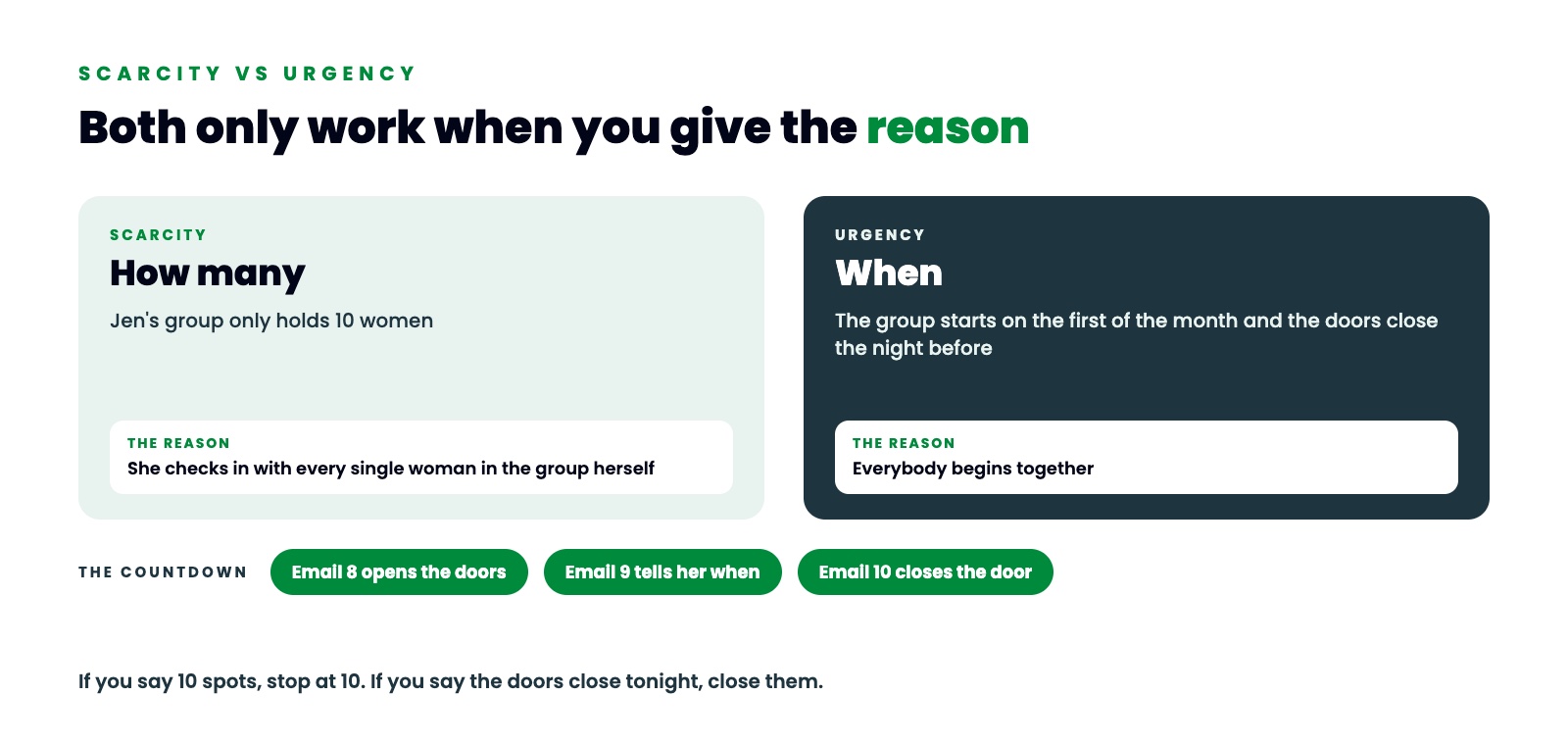
Jen's group only holds 10 women, because that's how many she can truly take care of at one time. So she tells Carol why. Her email says, "I only have 10 spots available because I check in with every single woman in the group myself, and I intentionally keep enrollments small."
She goes on to say she likes her programs to be more intimate and hands-on. That's why her group has such a high success rate.
Now Carol knows where the 10 comes from. The reason also tells her something about the program. She'd be one of 10 women getting Jen's direct attention.
Urgency gets a reason too. Jen's group starts on the first of the month, so everybody begins together. The doors close the night before. Carol can see why the deadline exists, so it reads as a fact about the program.
Save scarcity and urgency for the last three emails
I send 10 emails over 10 days, one per day. The last three are the countdown, and that's where scarcity and urgency belong.
Emails 1 through 7 do the belief work first. They help Carol see her problem, trust Jen and give herself permission to change. The countdown starts after that work is done.
A deadline can't change what somebody believes. If Carol got a deadline in email one, she'd be gone. She doesn't think she has a problem yet, so a deadline that early only feels like pressure from a stranger.
By email 10, Carol sees the problem and knows Jen's probably the right coach. She's also given herself permission to fix her problem before it gets out of hand. The one excuse left standing is "I'll start later." Urgency removes that excuse when it's done right.
Email 8 opens the doors
Email 8 tells Carol the details. That includes the start date, the guaranteed outcomes if there are any, and how many spots are available right now. This is where she first hears the number, and the reason comes with it.
Email 9 tells her when
Email 9 tells Carol when the chance is going to pass, usually tomorrow. It answers the questions Jen has gotten from past leads, so Carol feels completely informed. It's also a great place to link a case study or a highlight reel if you have one.
Email 10 closes the door
Email 10 is the hard pitch. It tells Carol the doors close tonight. It gives her the link and paints a picture of her next six weeks if she says yes.
Keep every word of it true
Urgency removes the last excuse only if every bit of it is true. If you say 10 spots, stop at 10. If you say the doors close tonight, close them.
Your lead has no way to check your numbers from the outside. She only has your word, and every email after this one depends on it.
The first time your last chance turns out to be fake, your lead stops trusting you. She won't believe another word you send her, and she stays on your list for every launch after this one.
This matters even more when your nurture sequence runs all year. Each new lead still needs a real deadline of her own. Inside Thrive Engine, you can create evergreen countdown funnels that give each new prospect a real deadline in your nurture sequence.
Write your own scarcity marketing lines
Start with your own program and write down its real limits.
How many people can you truly take care of at one time? That's your scarcity number. If you don't know it yet, count how many people you can check in with each week and still do it well. Start there. Write one sentence that tells a lead why the number is what it is, the way Jen ties her 10 spots to checking in with every woman herself.
When does your next group start, and why does everyone start together? That's your urgency. Write one sentence that gives the reason for the deadline.
The number and its reason go in email 8. The deadline goes in email 9, and email 10 closes the door.
Then read each line out loud and picture an 11th person asking to join after the 10th spot is gone. If you wouldn't tell her no, change the number until you would. Scarcity marketing built this way gives your lead real facts to decide with.
Once your emails are written, you build them into a workflow inside a CRM like Thrive Engine, so every new lead gets them in order, one per day.
I walk through all 10 emails, including the full countdown, in the full video, How to Get Coaching Clients With Email (Why Your Follow-Up Isn't Working). Watch it here: [VIDEO LINK]
FREE LEAD NURTURE PLAYBOOK
Get the free Lead Nurture Playbook
The Lead Nurture Playbook gives you all 10 emails written out in full, the psychology behind each one, and the AI prompt to make them your own.
Comment NURTURE on any of my posts, or DM NURTURE to @mythriveengine on Instagram, and I'll send it to you.
Want help building your own nurture system? Book a Thrive Engine demo.
