
How to Sell Coaching Online: The 3 Things That Happen Before Anyone Buys
Before anyone joins your coaching program, three things have to happen in their head. First, they have to realize they have a problem and a big one. Second, they have to believe you're the right coach to get them through it. Third, they have to give themselves permission to fix it, both logically and emotionally.
That's the whole job when you sell coaching online. This post shows you how each of the three works and how your follow-up emails make each one happen.
Why a good offer still doesn't sell
A lot of coaches blame the price or the offer when nobody buys. So they drop the price or add a bonus. Then they get the same result.
In the video this post comes from, I put it this way. "If you miss any one of these, they won't buy, no matter how good your offer is."
I'll show you what that looks like with two example characters I made up for the video. Jen is a 48 year old fitness coach. She helps women over 40 lose weight on a GLP-1 without losing their muscle. Her program is $1,495. Her members can expect to be down 10 to 15 pounds in 6 to 8 weeks while they keep their muscle.
Carol is Jen's newest lead. She's 51 and she's been on the shot for three months. She can fit into her high school clothes again, and she's convinced she's crushing it. Right now Carol doesn't think she has a problem at all.
So why would she hire a coach? She wouldn't. As far as Carol's concerned, she's already winning. The first of the three things has to happen before any offer can work.
The psychology of buying in one picture
Here's how it works. Each of the three things gets its own emails in your nurture sequence. I send 10 emails over 10 days, one per day, and each one has a job.
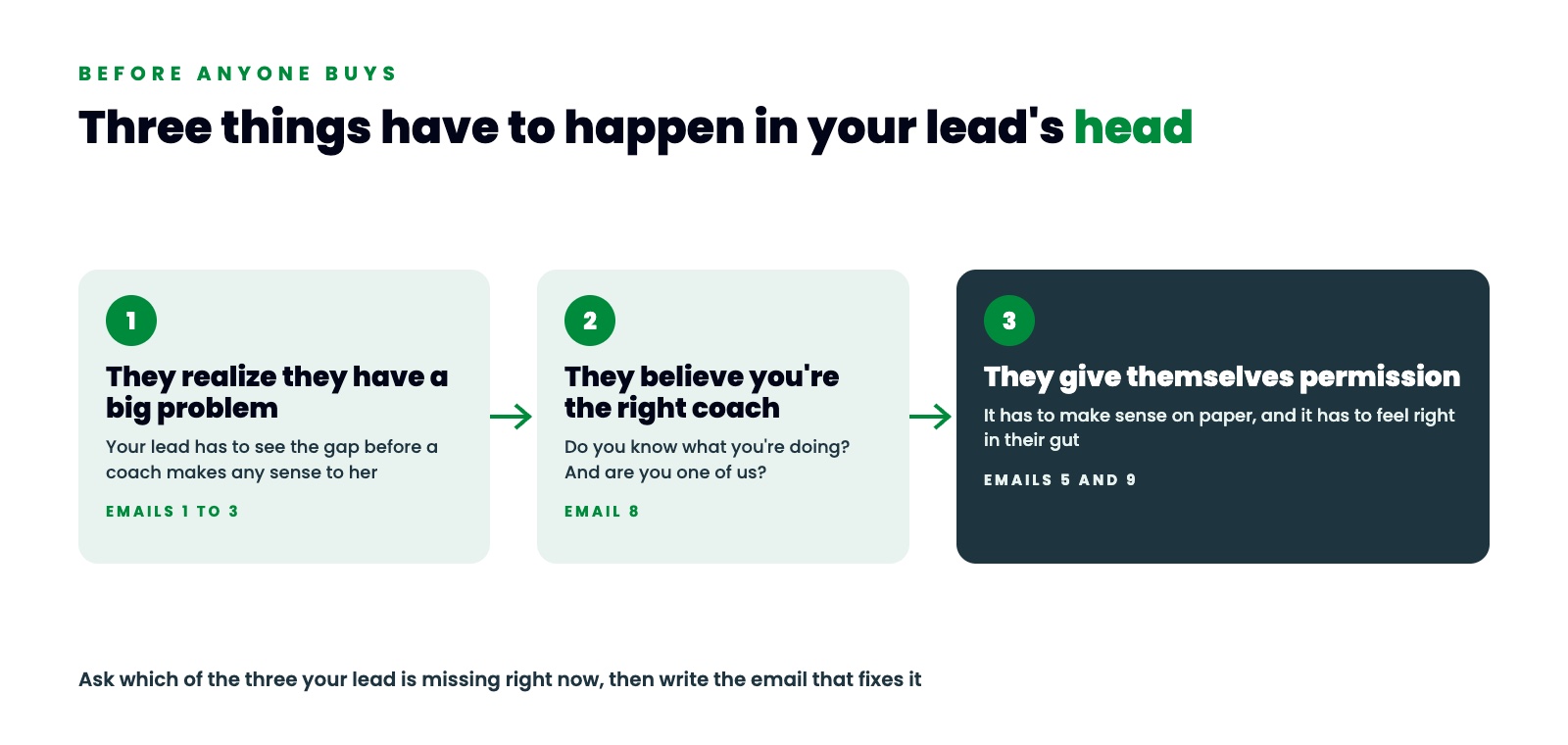
The first three emails help your lead see the problem. Email 8 shows her you're the right coach. Email 9 gives her the logical reasons to move forward. The emotional side of permission builds over the sequence, and email 5 is a good example.
The order matters. A lead who doesn't see a problem won't care who the right coach is. And a lead who doesn't trust you won't give herself permission to spend money with you.
Thing 1: They realize they have a real problem
Your lead may feel fine. Carol thinks the scale going down means everything's working.
Email 1 is the welcome. It's built on an idea from a copywriter named Eugene Schwartz. You can't make somebody want something. All you can do is take what they already want and point it in a new direction. So Jen opens with what Carol already wants, which is the scale going down. Then she plants a new thought. The scale can't tell you what you're actually losing.
Email 2 runs on loss aversion. Two researchers, Daniel Kahneman and Amos Tversky, found that losing something hurts about twice as much as gaining the same thing feels good. So Jen doesn't talk about what Carol could gain. She shows Carol what she's losing right now, which is muscle and every calorie that muscle used to burn for her.
Email 3 follows David Ogilvy's rule that facts sell. In one of the biggest GLP-1 studies, people who came off the drug put back on two thirds of the weight within a year. As I said in the video, "A real number from a real study beats my opinion every single time."
Nobody's tricking Carol here. That's what the research shows. By the end of email 3 she should be clearly seeing some gaps.
Thing 2: They believe you're the right coach
Once your lead sees the problem, she starts asking a new question. Who can help me fix this?
Email 8 opens the doors to the program and answers that question. It runs on authority. Chase Hughes teaches behavior and influence. He says people look for two things before they follow anybody. Do you know what you're doing? And are you one of us?
Jen has a head start on the second one. She's over 40 and she's in amazing shape. She's the picture of where Carol wants to end up.
So in email 8 Jen tells Carol why she does this work, how long she's been at it and how many women over 40 she's helped. Then she lays out the program in plain English. I call this the gain email, because it clearly lists every benefit of the program and how it's going to change things for Carol.
Your version of email 8 uses your real story and your real numbers.
Thing 3: They give themselves permission
Your lead can see the problem and trust you completely and still not buy. She has to say yes to herself first.
Permission comes in two parts. "It has to make sense on paper, and it has to feel right in their gut."
Make it make sense on paper
Email 9 handles the logical side, so I call it the logic email. It answers whatever your lead is still chewing on, and the big one is usually money. Carol's version sounds like this. "I'm already paying for the shot, so how am I supposed to pay for a coach too?"
This email runs on status quo bias. When we're unsure, we usually keep doing whatever we're already doing, even when it isn't working. So the email shows Carol that doing nothing is a choice too, and a costly one. A qualified coach helps her protect the money she's already pouring into the shot.
Email 9 uses the same true numbers from email 3. Nothing new and nothing scary.
Make it feel right in the gut
The emotional side builds across the sequence. Your lead needs to picture herself doing the work.
Psychologist Albert Bandura called this self-efficacy. People only try something when they believe they can actually pull it off. So in email 5 Jen hands Carol small and easy first steps, like two short 15-minute strength workouts at home every week, even if she's never picked up a weight. Carol can picture herself doing every one of them.
When Carol can see herself doing it and the numbers make sense, she can give herself permission. Then the enrollment can happen.
How to sell coaching with one question
Before you write a single follow-up email, ask yourself one question. "Which of those three is my lead missing right now?" Then write the email that fixes it.
If your leads keep saying they're doing fine on their own, they're missing the first one. Write more emails that help them see the problem. If they see the problem but go quiet when you mention your program, they're missing the second one. Show them what you've done and why you're one of them. If they tell you it's not the right time or the money's tight, they're missing the third one. Give them the logic and the small first steps.
Coaching sales get a lot easier once you know which of the three you're working on. You stop guessing and you start writing the email your lead actually needs.
Sell coaching online by caring enough to tell the truth
Some coaches feel pushy writing emails like these. Showing a lead a problem she can't see is honest work when your intentions are good. Jen wakes up every day wanting to keep women over 40 on a GLP-1 from wrecking their metabolism on the way to their goal weight. As I said in the video, "That's the most honest thing a coach can do is care."
That's how you sell coaching online. Work through the three things in order, one email at a time. Once your emails are written, you load them into a workflow in a CRM like Thrive Engine so every new lead gets them in order.
I walk through all 10 emails and the psychology behind each one in the full video, How to Get Coaching Clients With Email (Why Your Follow-Up Isn't Working). Watch it here: [VIDEO LINK]
FREE LEAD NURTURE PLAYBOOK
Get the free Lead Nurture Playbook
The Lead Nurture Playbook gives you all 10 emails written out in full, the psychology behind each one, and the AI prompt to make them your own.
Comment NURTURE on any of my posts, or DM NURTURE to @mythriveengine on Instagram, and I'll send it to you.
Want help building your own nurture system? Book a Thrive Engine demo.
